
Just In

Exergy Gemini Turbine vs Ormat Ormega100: Geothermal Binary Power Comparison

A Whooping $126 Million Streams Into Indonesian Geothermal From USA

Exciting News: The United States Commits $126 Million to Indonesian Geothermal Energy Project

By:Robert Buluma

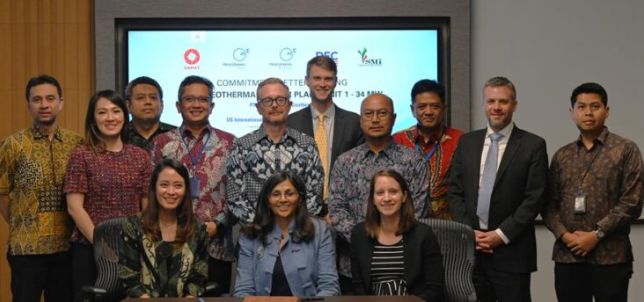
JAKARTA, INDONESIA – In a powerful stride towards a sustainable future, the U.S. International Development Finance Corporation (DFC) has announced a landmark investment of up to $126 million in the Indonesian power company PT Medco Cahaya Geothermal. This significant commitment, unveiled by DFC’s Deputy Chief Executive Officer Nisha Biswal, underscores a deepening partnership between the United States and Indonesia in the realm of renewable energy.

A Boost for Indonesia’s Energy Security

The investment will bolster the development of the Ijen Geothermal power plant’s 31MW Phase I in East Java, a densely populated province with 40 million residents. This project promises to enhance the Java-Bali grid, Indonesia's largest power system, by providing essential low-carbon baseload power. With this initiative, the United States and Indonesia are not only aiming to strengthen energy security but also to promote a cleaner and more sustainable energy infrastructure.

Strategic Partnership for a Just Energy Transition

The timing of this commitment is crucial as Indonesia pursues its Just Energy Transition Partnership (JETP), an initiative forged with global leaders during its G20 presidency. Power grid enhancements are pivotal to this strategy, and the Ijen Geothermal project is set to play a key role. The project exemplifies the collaborative spirit between Indonesia and the United States, highlighting their shared goals in advancing infrastructure, renewable energy, and small business support.

Reinforcing Shared Goals

At the ceremonial signing event in Jakarta, DCEO Nisha Biswal emphasized the importance of this project within the broader U.S.-Indonesia Comprehensive Strategic Partnership. "The Ijen Geothermal power plant is a key part of Indonesia’s ambitious strategy for an energy transition," said Biswal. "This project also reinforces our shared goals through the U.S.-Indonesia Comprehensive Strategic Partnership, which will enhance economic and energy security for both of our countries."

A History of Investment and Empowerment

This latest investment follows a November 2023 announcement by the DFC, which saw $131 million funneled into small businesses and women’s economic empowerment in Indonesia. These initiatives are part of the U.S. Government's broader Indo-Pacific Strategy, which includes the Indo-Pacific Economic Framework and the Partnership for Global Infrastructure and Investment, all aimed at bolstering economic ties and infrastructure development in the region.
The Road Ahead

The U.S. International Development Finance Corporation continues to lead with investments that address critical challenges in developing countries. From energy and healthcare to infrastructure and small businesses, DFC's projects are designed to uphold high standards, respecting the environment, human rights, and worker rights.

As Indonesia and the United States advance their partnership through groundbreaking projects like the Ijen Geothermal power plant, the future looks brighter for sustainable energy and economic development in the region. This collaboration not only sets a precedent for future initiatives but also exemplifies the power of international cooperation in tackling global challenges.

As the world grapples for a Just Energy transition we have also seen Oil and gas companies also going beyond Geothermal

Stay tuned for more updates on this and other transformative projects shaping the future of Indonesia and its dynamic partnership with the United States.

Source:Us Embassy

Connect With Us:Alphaxioms

Comments

Popular posts from this blog

GA Drilling: Advanced Geothermal Drilling Technology, Deep Rock Innovation, and Clean Energy Financing

GA Drilling : Deep Drilling Technology, Financing, and Geothermal Scale-Up Image: A GA Drilling Bit GA Drilling is one of the more important technology companies in the geothermal sector because it is trying to solve a problem that has limited geothermal growth for decades: the cost, complexity, and risk of drilling deep wells in hard rock. Rather than operating a geothermal power plant itself, the company focuses on the drilling side of the value chain, developing technologies that can make deep geothermal wells faster, cheaper, and more reliable to build. That positioning gives it a different role from most geothermal developers, and it also makes it strategically significant for the future of clean baseload energy. The geothermal industry has always been constrained by subsurface uncertainty. Developers know where the heat is in a general sense, but they still must drill through high-temperature, abrasive, fractured, and often unpredictable rock to get there. In many projects, dril...

EGS Market Size and Investment Outlook

Enhanced Geothermal Systems (EGS) Market Size and Investment Outlook to 2034 Enhanced Geothermal Systems are at an inflection point. For years, EGS sat in the “promising but pre‑commercial” category of clean technologies, constrained by drilling cost, subsurface risk, and limited policy attention. That picture is now changing as next‑generation geothermal developers raise larger rounds, sign serious offtake agreements, and move projects from concept to execution.   At the same time, global demand for firm, low‑carbon power is rising faster than conventional geothermal can supply. Thermal plants are retiring, grids need 24/7 clean electricity, and policymakers are discovering that weather‑dependent renewables cannot carry the entire load alone. EGS is emerging as one of the few technologies capable of delivering baseload clean power using a resource available almost everywhere: deep, hot rock. Current EGS Market Size – Small but Strategic In absolute terms, the EGS market is s...

Geothermal Engineering Limited (GEL): Deep Geothermal Technology, Financing, and UK Clean Energy Expansion

Geothermal Engineering Limited (GEL) : Technology, Financing, and Progress Image : Ryan Law is the C.E.O at GEL Geothermal Engineering Limited (GEL) is one of the UK’s most important geothermal developers, with a flagship deep-geothermal project at United Downs in Cornwall and a growing strategy that combines electricity, heat, and lithium extraction. It has also attracted a mix of private capital, public grants, and bank financing to move from exploration and drilling into commercial operations. Company overview GEL was incorporated in 2008 and is registered in Cornwall as a private limited company focused on electricity production, utility construction, and test drilling and boring. Its core mission is to use geothermal resources beneath the ground to support low-carbon power, heating, cooling, and ultra-low-carbon lithium production in the UK. The company presents itself as a lean specialist team built around geothermal engineering, geology, and community engagement capabilities. ...

Barito Renewables’ $5 Billion Bid for EDC Signals a New Power Move in Southeast Asia’s Geothermal Market

Indonesian Billionaire Prajogo Pangestu’s $5 Billion Geothermal Bet Could Reshape Philippine Clean Energy A major deal is drawing attention across Southeast Asia’s energy sector: Indonesian billionaire Prajogo Pangestu’s Barito Renewables Energy has made an unsolicited $5 billion offer to acquire Energy Development Corp. (EDC), the largest geothermal company in the Philippines. The proposal, while still non-binding and subject to due diligence and approvals, signals just how strategically important geothermal energy has become in the region’s clean power race. If completed, the transaction would bring together one of Indonesia’s most prominent energy investors and the Philippines’ biggest geothermal operator in a deal that could influence both corporate strategy and regional renewable energy development. Even without a final agreement, the offer alone highlights the rising value of geothermal assets at a time when governments and investors are searching for dependable, low-carbon power...

Exergy Gemini Turbine vs Ormat Ormega100: Geothermal Binary Power Comparison

Exergy Gemini Turbine vs Ormat Ormega100: Two Different Paths to Geothermal Scale image : a thematic view of a geothermal turbine "blade" Geothermal power is entering a new phase. Two of the most important announcements in the sector point to larger, more standardized, and more commercially viable binary geothermal systems: Exergy’s Gemini Turbine and Ormat’s Ormega100 . At first glance, both machines promise major gains in scale, but they are not trying to solve the same problem in exactly the same way. Gemini is built around a high-capacity radial outflow turbine architecture that can deliver up to 60 MWe per shaft, while Ormega100 is designed as a 100 MW binary surface power unit intended to accelerate enhanced geothermal system commercialization. For project developers, utilities, and data-center buyers looking for firm clean power, the comparison matters because it reveals two competing ideas about how geothermal should grow. Exergy is emphasizing turbine architectur...

Enhanced Geothermal Systems (EGS) Induced Seismicity: Can We Engineer Earthquakes Safely?

Enhanced geothermal systems are one of the few realistic paths to firm zero carbon power at scale, but they work by deliberately changing stresses in the crust, so induced seismicity is not a bug; it is a built‑in consequence that we have to manage, not eliminate. Image: geothermal wells of power The real question is whether we can design and regulate EGS so that most earthquakes stay tiny and useful as a reservoir diagnostic, and rare felt events stay within a risk envelope society will accept, with clear rules on who pays when something still goes wrong. EGS and induced seismicity Enhanced geothermal systems increase permeability in hot but relatively tight rock by injecting fluid under pressure, which raises pore pressure and shifts effective stresses on pre‑existing fractures and faults. When those faults are close to failure, even modest pressure changes can trigger slip, generating induced seismic events that range from microquakes only instruments detect to felt earthquakes like...

EU Tripartite Energy Storage Agreement, EGEC and QHeat Drive 30–35 GW Storage Deployment, Geothermal Energy Storage, Flexible Renewable Integration, and Clean Energy Investment Opportunities

The new EU tripartite agreement on energy storage, with EGEC and QHeat among the signatories, gives you a strong “systems-level” angle to layer onto your California geothermal piece by showing how firm clean power and storage are being coordinated on both sides of the Atlantic. Image : UK First Geothermal power plant at United Dawn's by Enel Green Coordinated Clean Firm Power, How California’s Geothermal Push and Europe’s Energy Storage Tripartite Are Rewriting the Rules of the Grid California’s decision to fund geothermal exploratory wells and the EU’s first‑ever tripartite agreement on energy storage are two sides of the same strategic coin, both designed to deliver secure, flexible, and affordable clean electricity. While California is targeting next‑generation geothermal to close its “clean firm gap,” Brussels is rallying 22 Member States, industry, banks, and innovators around a shared pledge to add 30–35 GW of new storage capacity in just two years.Together, these moves sh...

Geothermal Project Finance Structuring: SPVs, Mezzanine Debt, Blended DFI Finance and Contingent Capital for Drilling Risk

Geothermal Project Finance Structuring: SPVs, Mezzanine Debt and Blended Capital for Drilling Risk Image : A depiction of a geothermal complete project  Geothermal power sits in an awkward place on the project finance spectrum. It behaves like long‑lived infrastructure once it’s operating, but it looks like frontier exploration during the early drilling phase. To build bankable deals in that environment, developers and investors have had to invent a toolkit of SPV structures, mezzanine drilling tranches, blended public–private finance and contingent instruments that allocate subsurface risk without blowing up returns. This is not just a technicality for lawyers and bankers. The way geothermal deals are structured determines whether otherwise viable resources ever reach financial close. It also shapes how much upside sponsors keep via GP carry, how quickly equity can recycle, and how development platforms position themselves in a crowded clean‑energy pipeline. Why geothermal is stru...

How AI-Powered Digital Twins Are Transforming Geothermal Reservoir Management

Geothermal Reservoir Digital Twins: How AI Is Transforming Reservoir Management Image : Thematic image of a geothermal heat pump Artificial intelligence and digital twins are quietly rewriting the playbook for geothermal reservoir management. They turn scattered subsurface data into living, predictive models that help operators boost output, cut drilling risk, and extend the productive time. How Geothermal Digital Twins Are Making Reservoirs Smarter, Safer, and More Profitable For decades, geothermal development has been constrained by one brutal fact: you can’t see 3 km underground. You infer, you model, you hope—and sometimes you drill into a dry or underperforming reservoir. AI‑powered geothermal digital twins change that equation by continuously updating subsurface models with real‑time data, making the invisible reservoir behave like a transparent, responsive system. In practice, geothermal digital twins are dynamic software replicas of wells, reservoirs, and surface facilities th...

The "Heat-as-a-Service" (HaaS) Business Model: Geothermal Without the CAPEX Nightmare

Heat-as-a-Service takes geothermal from a capital-intensive power project to a financeable, contract-based heat utility: instead of selling electrons, you sell stable, decarbonized heat under long-term contracts that match what industrial customers and investors actually want. Image: A thematic picture of a geothermal power plant By shifting risk and ownership away from end users and toward specialised developers and infrastructure capital, it can unlock geothermal in markets where electricity tariffs are low but demand for reliable, low-carbon process heat is strong. From kWh to “heat-as-a-service” Traditional geothermal projects earn revenue by selling electricity into a grid, often at wholesale prices that barely cover high up-front drilling and plant costs unless there is a feed-in tariff or premium.Many industrial users, however, do not need electricity; they need heat for processes like brewing, greenhouse climate control or pulp and paper production, and they currently buy that ...